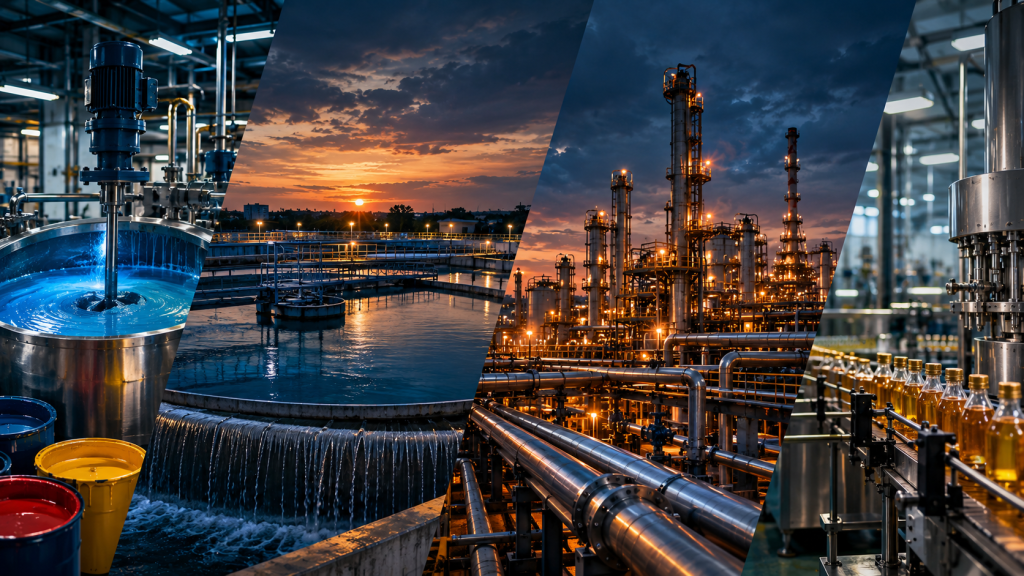
Selecting an antifoam is not a single decision. It is a series of decisions, each shaped by the specific conditions of the process where the foam is forming. The same silicone emulsion that resolves a foam problem in a water treatment plant can perform poorly in a paint formulation, and a grade that works well in ambient-temperature food processing may lose effectiveness at the elevated temperatures of a distillation column. Understanding which product fits which application is the difference between solving a foam problem and managing it indefinitely with repeated dosing.
Gotche Middle East supplies the full Berrelite antifoam range from Barrelyene International across the UAE, Pakistan, and the wider region. This article walks through the key application areas and the specific Berrelite grades that Barrelyene recommends for each, drawing on the product selector guide developed from field and laboratory testing across industry.
Food and Beverage Processing
Food and beverage processing generates foam across several distinct unit operations, and each has its own chemistry and regulatory requirements. Carbonated beverage production, fermentation, and vacuum distillation all create foam through different mechanisms and require different control approaches.
For general food process aid and carbonated beverage applications, the recommended grades are Berrelite AF1090, AF1050, FD1050, MDA-1800, MDA-1500, and MD-1000. These grades are formulated for food-contact compliance and perform across the aqueous, surface-active environments typical of beverage production lines.
Protein and starch foam, which is particularly persistent and difficult to control because the proteins that stabilize it are also the active product, responds well to Berrelite AF1090. Fermentation foam, which builds rapidly because biological activity continuously regenerates the surface-active proteins driving it, is handled by the MDA-1800, MDA-1500, and MD-1000 grades in aqueous fermentation systems.
Where vacuum distillation is involved, the grade selection depends on the nature of the medium. Hydrocarbon and solvent systems require Berrelite HCS-2244, a solvent-based grade that is compatible with non-aqueous environments where a water-based emulsion would cause problems. Aqueous systems in vacuum distillation respond to the MDA-1800 and MDA-1500 grades.
The regulatory dimension matters in this sector more than almost anywhere else. Any antifoam used in food processing must meet applicable FDA and USDA requirements, and where relevant must be certified kosher and parve. The Berrelite food-grade range is formulated with these requirements in mind, and product data sheets and safety data sheets are available from our team for compliance verification before use.
Paint and Coatings
Foam in paint and coatings manufacture is almost unavoidable. High-shear dispersion and mixing, which is fundamental to the process, disperses air into the liquid, and the resins, surfactants, and dispersants present stabilise that air as foam and micro-foam. The consequences include surface defects in the applied coating, reduced opacity from entrapped air, and process inefficiency from reduced effective batch volume.
For aqueous paint and coatings systems, the primary grades are Berrelite SD2050 and SD1030. Both are silicone emulsions formulated for paint and coatings applications, with SD1030 offering 30% silicone content and SD2050 offering 18%, allowing the formulator to match silicone loading to the foam character of the system.
The MDA series, specifically MDA-100, MDA-1500, MDA-1800, and MDA-3000, are also recommended for paint and coatings aqueous applications, particularly where food-contact or specific regulatory compliance requirements apply to the coating. The MD-1000 fluid grade and the glycol-based GD-100 and GD-50 grades round out the paint and coatings offering for applications where emulsion grades are not preferred.
For non-aqueous coatings and solvent-based systems, Berrelite HCS-2244 is the recommended grade, providing foam control in environments where the continuous phase is a hydrocarbon or polar solvent rather than water.
Water Treatment
Water treatment generates foam primarily through two routes: the aeration and agitation involved in biological treatment and clarification, and surfactant carry-over from the industrial process streams entering the treatment system. In both cases, foam reduces the effective capacity of treatment vessels, interferes with surface skimming and settling operations, and in biological systems can carry active biomass out of the reactor.
The recommended grades for water treatment aqueous systems are Berrelite SD110, SD1615, and SD2050. All three are silicone emulsions suited to aqueous environments across the pH range typical of water treatment operations, which tends toward the neutral to slightly alkaline. SD110 and SD1615 are the primary selections for water treatment and oil and gas aqueous systems, while SD2050 extends coverage to applications with more demanding foam character.
Dose rates in water treatment need careful management. Over-dosing a silicone antifoam in a biological treatment system can affect the microbial activity that the treatment depends on, so the approach is to find the minimum effective dose through controlled addition rather than treating antifoam as a bulk commodity input.
Oil and Gas
Oil and gas operations present some of the most demanding foam control challenges across industry, because foam arises in multiple unit operations, process conditions are frequently extreme in terms of temperature and pressure, and the consequences of poor foam control are measured in separator efficiency, product loss, and equipment integrity.
Gas sweetening, in which amine solutions absorb H2S and CO2 from natural gas streams, is particularly prone to foaming because the amine itself is surface-active and the gas-liquid contact involved in absorption is continuous. Berrelite SD1615 and SD2050 are the recommended grades for gas sweetening, offering the silicone loading and emulsion stability needed for this environment.
Gas-oil separation relies on gravity and residence time to separate oil, water, and gas phases, and foam in the separator reduces effective residence time and carries liquid into the gas outlet. Berrelite SD2050, SD1030, SD5040, and SD1000 are recommended for gas-oil separator applications, with the higher-silicone grades SD5040 and SD1000 suited to the more demanding separation environments where foam knockdown and persistence both need to be strong.
Distillation columns in refining and gas processing are handled by the SD5040 and SD1000 grades. Bitumen emulsification, a specific application in oil processing, responds to a broader selection including SD110, SD1615, SD2050, MDA-1800, MDA-1500, SD5040, and SD1000, with grade selection depending on the specific emulsification conditions.
Chemical and Plastics Processing
Polymer production, particularly emulsion polymerisation and latex production, generates foam through the combination of agitation, surfactant use, and gas-liquid contact inherent in the process. Controlling this foam without affecting the polymerisation reaction or the final polymer properties requires grades that are both effective and chemically compatible with the polymerisation system.
For latex and emulsion polymerisation, the recommended grades are Berrelite SD1615, SD2050, MDA-1800, MDA-1500, SD5040, and SD1000. The choice between them depends on whether the system is aqueous or semi-polar and on the specific surfactant chemistry involved in the polymerisation.
For mineral and pigment processing, specifically phosphate processing and titanium dioxide production, the MDA-1800 and MDA-1500 grades are the established recommendation. These applications involve highly loaded aqueous slurries where silicone emulsion stability under process conditions matters as much as foam knockdown performance.
Surfactant solutions, which are inherently prone to foaming and require foam control during manufacture and handling, respond to the SD2050, SD1030, and SD1000 grades.
Pulp and Paper
Pulp and paper processing generates foam across multiple stages, from pulp washing and screening through to the paper machine itself, driven by the lignosulphonates, fatty acids, and surfactants present in the process streams. Foam control in this sector needs to be effective without affecting sheet formation or coating quality.
The recommended grades for pulp and paper applications are Berrelite MDA-1800, MDA-1500, MD-1000, GD-100, GD-50, and HCS-2244. The MDA and MD series cover the aqueous process stages, while the glycol-based GD grades and the solvent-based HCS-2244 cover non-aqueous applications within the process.
Getting the Selection Right
The selector guide above provides the starting point for grade selection. The right approach is to take the two or three grades most suited to your application and test them in your specific process using the shake test or recirculation test, or both, before committing to a supply programme. Antifoam performance is process-specific, and the investment in a short evaluation programme almost always pays back in the form of a better-performing, lower-cost solution than defaulting to whatever grade is immediately available.
Gotche Middle East can supply product data sheets, safety data sheets, and sample quantities of Berrelite antifoam grades for evaluation in your process. Contact our team at ask@gotcheme.com or call +971 56 5058564 with your application details, the industries and process stages where foam is causing problems, and any regulatory requirements that apply, and we will identify the right starting point for your evaluation.
FAQs
Which Berrelite grade is recommended for oil and gas gas sweetening?
Berrelite SD1615 and SD2050 are the standard grades for gas sweetening. For gas-oil separator applications, SD2050, SD1030, SD5040, and SD1000 cover the range, with the higher-silicone grades suited to more demanding separation conditions.
Can the same antifoam grade be used across multiple industries?
Some grades have broad applicability. Berrelite SD2050, for example, covers paint and coatings, water treatment, oil and gas, and chemical processing. That said, performance is always process-specific, so testing in your actual system before full-scale use is always recommended.
What antifoam grades are suitable for emulsion polymerisation?
Berrelite SD1615, SD2050, MDA-1800, MDA-1500, SD5040, and SD1000 are the recommended grades. The right choice depends on whether the system is aqueous or semi-polar and the specific surfactant chemistry involved.
How should antifoam dose rates be managed in biological water treatment systems?
Carefully. Excess silicone antifoam can affect the microbial activity that biological treatment depends on. Establish the minimum effective dose through controlled addition trials rather than dosing heavily. The SD110, SD1615, and SD2050 grades are effective at low dose rates, which supports this approach.
Are there Berrelite grades suitable for non-aqueous and solvent-based systems?
Yes. Berrelite HCS-2244 is a solvent-based grade for hydrocarbon and polar solvent environments where a water-based emulsion would be incompatible. The glycol-based GD-100 and GD-50 grades are also available where glycol compatibility is preferred.