Uncategorized
Choosing the Right Antifoam for Your Industry: A Practical Guide to the Berrelite Range
Selecting an antifoam is not a single decision. It is a series of decisions, each shaped by the specific conditions…
Read More ↗
Blog
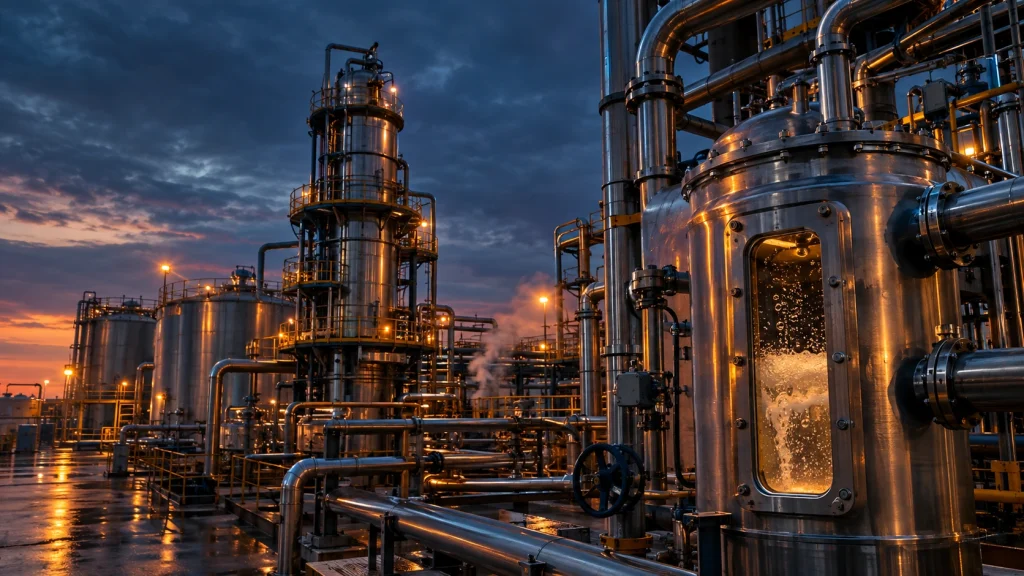
Foam is one of the most underestimated problems in industrial processing. It slows production, reduces equipment capacity, interferes with quality control, causes product loss, and in some processes creates genuine safety hazards. Yet the solution is rarely a major engineering project. In most cases, the right chemical foam control agent, added at the right point in the process at the right concentration, resolves the problem cost-effectively without any changes to the underlying operation.
Gotche Middle East supplies the Berrelite antifoam and defoamer range from Barrelyene International, a product line developed for exactly this kind of problem across a wide range of industries and applications. This article explains how antifoams and defoamers work, what makes them effective, and how to select the right grade for your process.
The terms are used interchangeably in most industrial contexts, but they describe slightly different modes of action. A defoamer is added to an already-foaming system to break the existing foam down. Its primary job is foam knockdown. An antifoam is added before foam develops, or immediately after a knockdown, to prevent the foam from building back up. Its primary job is persistence, meaning the duration over which it suppresses re-foaming.
In practice, most industrial foam control agents combine both functions. A product that knocks foam down quickly but has no persistence forces repeated dosing, which increases cost and complicates process management. A product with good persistence but poor knockdown leaves existing foam in place too long. The best solutions balance both, and the Berrelite range from Barrelyene International is formulated with that balance in mind across different application environments.
Foam forms when a gas, typically air or a process gas, is dispersed through a liquid that contains surface-active agents such as surfactants, proteins, polymers, or other materials that stabilise the interface between gas and liquid. These surface-active materials lower surface tension and form a film around each gas bubble, giving the foam its structure and preventing the bubbles from coalescing and collapsing.
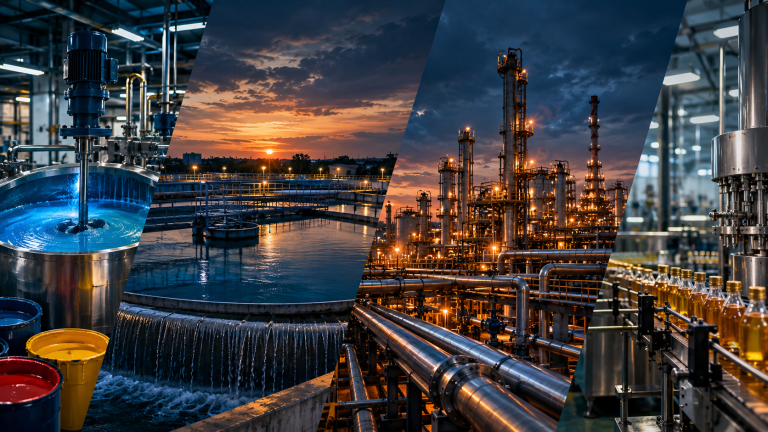
In food and beverage processing, fermentation naturally produces surface-active proteins that stabilise foam. In water treatment, surfactant carry-over from industrial processes creates persistent foam in aeration tanks and clarifiers. In coatings and paints, high-shear mixing disperses air into the liquid and the resins and surfactants present stabilise it. In oil and gas operations, gas sweetening and gas-oil separation both involve gas-liquid contact that generates foam, which interferes with separator efficiency and downstream equipment.
The consequences are process-specific but consistently costly. Foam reduces the effective volume of a reactor or vessel, meaning you get less product from the same equipment. It can cause process upsets by triggering level sensors or overflow controls. It entrains product into vent lines or scrubbers. In fermentation, it can carry active biomass out of the vessel. And in many cases it simply slows operations down because the process has to be run more conservatively to avoid foam-related incidents.
For a chemical foam control agent to work, it needs to meet several requirements. It must have a lower surface tension than the foaming medium it is added to, because this allows it to spread across the foam film and disrupt it. It must disperse readily through the system so it reaches the foam quickly and uniformly. It must have poor solubility in the system, meaning it stays as a distinct phase rather than dissolving into the bulk liquid, because it is the presence of a separate phase that physically destabilises the foam film. It must be chemically inert so it does not react with the process materials. And it must leave no substantial residue or odour, and meet regulatory requirements including FDA and USDA approvals where the application demands them.
Silicone-based foam control agents meet all of these requirements across a broad range of applications and are the most widely used antifoam chemistry in industrial use today. Because they are effective at very low dose rates, they are frequently cost-competitive even where the unit cost of the silicone product is higher than alternatives.
Selecting an antifoam requires testing in the actual process environment, because the same product can perform very differently in two systems that appear superficially similar. Two standard testing approaches are used across industry.
The shake test is the most common. The antifoam is added to a foaming medium in a closed container, which is then shaken for a defined period either by hand or with automated equipment. The time for the foam to collapse and the amount of foam remaining after shaking are measured and compared between candidate products. It is quick to run and useful for initial screening, though it may not reproduce the shear conditions of the real process.
The recirculation test is more demanding. A glass vessel is partially filled with the foaming medium and a pump recirculates the liquid from the bottom, re-injecting it from the top to create a continuous falling stream that entrains air and builds foam rapidly. The antifoam is added when the foam reaches the vessel top, and the rate at which the foam collapses is measured as knockdown performance. The test then continues to measure how long it takes for the foam to rebuild, which gives the persistence figure. This test more closely replicates the shear conditions of real industrial processes and is the more reliable predictor of field performance.
No laboratory test fully replicates every industrial process, which is why the recommendation is always to evaluate several antifoam grades in each specific system to determine the type and concentration that delivers optimum results.
Barrelyene International’s Berrelite antifoam range covers silicone emulsions, glycol-based products, fluid silicones, and solvent-based grades, formulated to cover the full range of industry requirements.
The emulsion grades including Berrelite SD1615, SD2050, SD1030, SD5040, and SD1000 are water-based silicone emulsions suited to aqueous systems including water treatment, oil and gas, paint and coatings, and detergent applications. Silicone content ranges from 10% to 50% and viscosity from 1,500 to 8,000 centipoise depending on grade, allowing selection based on the specific foam character and application method of the process.
The MDA series including Berrelite MDA-100, MDA-1500, MDA-1800, and MDA-3000 are silicone emulsions formulated specifically for food processing, paint and coatings, and paper and pulp applications, with food-contact compliance where required.
The fluid and glycol-based grades including Berrelite MD-1000, GD-100, and GD-50 cover applications where a water-based emulsion is not appropriate, including food processing, paper and pulp, and coatings work where glycol compatibility is preferred.
The solvent-based grade Berrelite HCS-2244 is formulated for non-aqueous systems including hydrocarbon and solvent vacuum distillation where a water-based emulsion would be incompatible.
Selecting the right antifoam requires working through four key factors: the chemical nature of the foaming medium (aqueous, semi-polar, or non-polar), the operating temperature, the pH range of the system, and the specific application and its regulatory requirements.
For oil and gas gas sweetening and gas-oil separation, the SD1615 and SD2050 emulsion grades are established choices. For paint and coatings aqueous systems, SD2050, SD1030, and the MDA series are the primary candidates. For food and beverage processing including fermentation and carbonated beverage production, the AF1090, AF1050, FD1050, MDA-1800, and MDA-1500 grades are recommended. For water treatment aqueous systems, the SD110, SD1615, and SD2050 grades are the standard selection. For chemical and plastics including latex polymerisation and emulsion polymerisation, the SD series grades are the primary option.
In all cases, the final selection should be made after running both the shake test and, where the process involves high shear or elevated temperature, the recirculation test across a short-list of candidate grades.
Gotche Middle East supplies the Berrelite antifoam and defoamer range as part of our performance chemicals offering, drawing on Barrelyene International’s product line and technical expertise. If you are evaluating antifoam options for a process in the UAE, Pakistan, or the wider region, our team can provide product data sheets, safety data sheets, and guidance on grade selection for your specific application. Contact us at ask@gotcheme.com or call +971 56 5058564 with your application details and we will come back with the right starting point.
A defoamer breaks existing foam down quickly. An antifoam prevents foam from rebuilding after knockdown. Most industrial products combine both functions, balancing how fast foam collapses with how long it stays down.
They have very low surface tension, spread rapidly across foam films, stay inert in most process environments, and work at extremely low dose rates. That low dose rate makes them cost-competitive even against cheaper alternatives, because far less product is needed to achieve the same result.
Start with four factors: whether your system is aqueous, semi-polar, or non-polar; the operating temperature; the pH range; and any regulatory requirements. Barrelyene’s selector guide narrows it to two or three candidate grades, which should then be tested in your actual process before committing to a supply programme.
Yes. Several Berrelite grades are formulated for food-contact applications and meet FDA and USDA requirements. The AF1090, AF1050, FD1050, MDA-1800, MDA-1500, and MD-1000 grades cover carbonated beverage production, fermentation, and general food process aids.
Contact our team at ask@gotcheme.com or call +971 56 5058564 with your application details. We can provide data sheets, safety data sheets, and sample quantities for evaluation.
Selecting an antifoam is not a single decision. It is a series of decisions, each shaped by the specific conditions…
Read More ↗